Let Do It Cole Porter Sheet Music Free Download Pdf
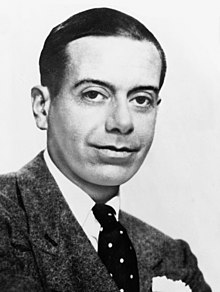
Cole Albert Porter (June 9, 1891 – Oct 15, 1964) was an American composer and songwriter. Many of his songs became standards noted for their witty, urbane lyrics, and many of his scores constitute success on Broadway and in picture.
Built-in to a wealthy family in Indiana, Porter defied his grandfather's wishes and took upwards music as a profession. Classically trained, he was drawn to musical theatre. Afterwards a tedious start, he began to achieve success in the 1920s, and past the 1930s he was one of the major songwriters for the Broadway musical stage. Unlike many successful Broadway composers, Porter wrote the lyrics too equally the music for his songs. After a serious horseback riding accident in 1937, Porter was left disabled and in constant hurting, simply he connected to work. His shows of the early on 1940s did non contain the lasting hits of his best work of the 1920s and 1930s, only in 1948 he made a triumphant comeback with his most successful musical, Kiss Me, Kate. It won the first Tony Laurels for Best Musical.
Porter's other musicals include Fifty One thousand thousand Frenchmen, DuBarry Was a Lady, Anything Goes, Tin can-Can and Silk Stockings. His numerous striking songs include "Night and Day", "Brainstorm the Beguine", "I Get a Kick Out of Yous", "Well, Did You Evah!", "I've Got You Under My Pare", "My Heart Belongs to Daddy" and "You're the Superlative". He also equanimous scores for films from the 1930s to the 1950s, including Born to Trip the light fantastic (1936), which featured the song "You'd Be So Easy to Love"; Rosalie (1937), which featured "In the Withal of the Dark"; High Society (1956), which included "True Love"; and Les Girls (1957).
Life and career [edit]
Early years [edit]
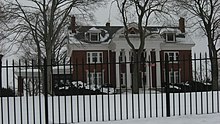
Farmhouse at Westleigh Farms
Porter was born in Peru, Indiana, the just surviving child of a wealthy family.[n 1] [two] His begetter, Samuel Fenwick Porter, was a druggist past merchandise.[3] [n 2] His female parent, Kate, was the indulged daughter of James Omar "J. O." Cole, "the richest man in Indiana", a coal and timber speculator who dominated the family.[five] [n 3] J. O. Cole built the couple a firm on his Peru-area belongings, known every bit Westleigh Farms.[7] Later high schoolhouse, Porter returned to his childhood domicile only for occasional visits.[8]
Porter'south strong-willed mother doted on him[9] and began his musical training at an early historic period. He learned the violin at historic period six, the piano at 8, and wrote his first operetta (with aid from his mother) at ten. She falsified his recorded nascence yr, changing it from 1891 to 1893 to make him announced more precocious.[five] His father, a shy and unassertive man, played a bottom role in Porter'south upbringing, although as an amateur poet, he may take influenced his son's gifts for rhyme and meter.[3] Porter'southward begetter was also a talented singer and pianist, but the father-son relationship was non close.[9]

J. O. Cole wanted his grandson to go a lawyer,[five] and with that in heed, sent him to Worcester Academy in Massachusetts in 1905. Porter brought an upright piano with him to schoolhouse[10] and found that music, and his ability to entertain, fabricated it easy for him to make friends.[x] Porter did well in schoolhouse and rarely came home to visit.[11] He became form valedictorian[5] and was rewarded by his grandfather with a bout of French republic, Switzerland and Germany.[12] Entering Yale College in 1909, Porter majored in English, minored in music, and besides studied French.[thirteen] He was a member of Curlicue and Central and Delta Kappa Epsilon fraternity, and contributed to campus humor magazine The Yale Record.[xiv] He was an early member of the Whiffenpoofs a cappella singing group and participated in several other music clubs;[15] in his senior year, he was elected president of the Yale Glee Social club and was its principal soloist.[13]
Porter wrote 300 songs while at Yale,[5] including student songs such every bit the football fight songs "Bulldog"[16] and "Bingo Eli Yale" (aka "Bingo, That's The Lingo!") that are nonetheless played at Yale.[17] [18] During college, Porter became acquainted with New York City's vibrant nightlife, taking the railroad train there for dinner, theater, and nights on the boondocks with his classmates, before returning to New Haven, Connecticut, early in the morning.[15] He likewise wrote musical comedy scores for his fraternity, the Yale Dramatic Association, and equally a student at Harvard – Cora (1911), And the Villain Nevertheless Pursued Her (1912), The Pot of Gold (1912), The Kaleidoscope (1913) and Paranoia (1914) – which helped prepare him for a career every bit a Broadway and Hollywood composer and lyricist.[13] After graduating from Yale, Porter enrolled in Harvard Constabulary Schoolhouse in 1913, where he roomed with future Secretary of State Dean Acheson.[19] He presently felt that he was not destined to be a lawyer, and, at the suggestion of the dean of the police force school, switched to Harvard'south music section, where he studied harmony and counterpoint with Pietro Yon.[3] His mother did not object to this move, merely it was kept cloak-and-dagger from J. O. Cole.[5]
In 1915, Porter's first song on Broadway, "Esmeralda", appeared in the revue Hands Upwardly. The quick success was immediately followed past failure: his commencement Broadway production, in 1916, Encounter America Outset, a "patriotic comic opera" modeled on Gilbert and Sullivan, with a book by T. Lawrason Riggs, was a bomb, endmost after two weeks.[20] Porter spent the next year in New York City before going overseas during Earth War I.[13]
Paris and matrimony [edit]
In 1917, when the The states entered World War I, Porter moved to Paris to work with the Duryea Relief organization.[21] [n four] Some writers have been skeptical about Porter's claim to take served in the French Foreign Legion,[5] [20] but the Legion lists Porter equally one of its soldiers and displays his portrait at its museum in Aubagne.[23] Past some accounts, he served in North Africa and was transferred to the French Officers School at Fontainebleau, instruction gunnery to American soldiers.[24] An obituary discover in The New York Times stated that, while in the Legion, "he had a specially synthetic portable pianoforte made for him so that he could carry it on his dorsum and entertain the troops in their bivouacs."[25] Some other account, given by Porter, is that he joined the recruiting department of the American Aviation Headquarters, just, according to his biographer Stephen Citron, at that place is no record of his joining this or whatsoever other co-operative of the forces.[26]
Porter maintained a luxury flat in Paris, where he entertained lavishly. His parties were extravagant and scandalous, with "much gay and bisexual action, Italian nobility, cantankerous-dressing, international musicians and a large surplus of recreational drugs".[5] In 1918, he met Linda Lee Thomas, a rich, Louisville, Kentucky-born divorcée eight years his senior.[2] [n five] She was beautiful and well-continued socially; the couple shared common interests, including a dear of travel, and she became Porter's confidante and companion.[28] The couple married the post-obit twelvemonth. She was in no dubiety about Porter's homosexuality,[n 6] merely it was mutually advantageous for them to marry. For Linda, it offered connected social status and a partner who was the antonym of her abusive first husband.[27] For Porter, it brought a respectable heterosexual front in an era when homosexuality was not publicly best-selling. They were, moreover, genuinely devoted to each other and remained married from Dec 19, 1919, until her death in 1954.[five] Linda remained protective of her social position and, believing that classical music might be a more prestigious outlet than Broadway for her husband's talents, tried to use her connections to find him suitable teachers, including Igor Stravinsky, only was unsuccessful. Finally, Porter enrolled at the Schola Cantorum in Paris, where he studied orchestration and counterpoint with Vincent d'Indy.[three] Meanwhile, Porter's kickoff large hit was the song "One-time-Fashioned Garden" from the revue Hitchy-Koo in 1919.[2] In 1920, he contributed the music of several songs to the musical A Dark Out.[thirty]
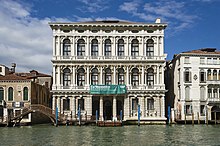
Spousal relationship did not diminish Porter'south taste for extravagant luxury. The Porter home on the rue Monsieur near Les Invalides was a deluxe firm with platinum wallpaper and chairs upholstered in zebra skin.[25] In 1923, Porter came into an inheritance from his granddad, and the Porters began living in rented palaces in Venice. He one time hired the entire Ballets Russes to entertain his guests, and for a party at Ca' Rezzonico, which he rented for $four,000 a month ($61,000 in current value), he hired fifty gondoliers to act equally footmen and had a troupe of tightrope walkers perform in a blaze of lights.[25] In the midst of this extravagant lifestyle, Porter continued to write songs with his wife's encouragement.[31]
Porter received few commissions for songs in the years immediately after his union. He had the occasional number interpolated into other writers' revues in Britain and the U.South. For a C. B. Cochran bear witness in 1921, he had two successes with the one-act numbers "The Blue Boy Blues" and "Olga, Come Back to the Volga".[32] In 1923, in collaboration with Gerald Murphy, he composed a short ballet, originally titled Landed and and so Within the Quota, satirically depicting the adventures of an immigrant to America who becomes a film star.[33] The work, written for the Ballets suédois, lasts about 16 minutes. Information technology was orchestrated by Charles Koechlin and shared the same opening night as Milhaud'southward La création du monde.[34] Porter's work was one of the earliest symphonic jazz-based compositions, predating George Gershwin'southward Rhapsody in Blue by four months, and was well received past both French and American reviewers subsequently its premiere at the Théâtre des Champs-Élysées in October 1923.[34] [n 7]
Subsequently a successful New York performance the post-obit month, the Ballets suédois toured the work in the U.S., performing it 69 times. A twelvemonth afterward the company disbanded, and the score was lost until information technology was reconstructed from Porter's and Koechlin's manuscripts between 1966 and 1990, with help from Milhaud and others.[36] Porter had less success with his work on The Greenwich Village Follies (1924). He wrote most of the original score, but his songs were gradually dropped during the Broadway run, and by the time of the mail-Broadway bout in 1925, all his numbers had been deleted.[37] Frustrated by the public response to almost of his piece of work, Porter nearly gave up songwriting as a career, although he continued to etch songs for friends and perform at private parties.[31]
Broadway and W End success [edit]

At the age of 36, Porter reintroduced himself to Broadway in 1928 with the musical Paris, his kickoff hit.[38] Information technology was commissioned by E. Ray Goetz at the instigation of Goetz'southward wife and the show's star, Irène Bordoni.[38] She had wanted Rodgers and Hart to write the songs, only they were unavailable, and Porter's amanuensis persuaded Goetz to hire Porter instead.[39] In August 1928, Porter'south work on the show was interrupted by the death of his father. He hurried back to Indiana to comfort his female parent before returning to work. The songs for the show included "Let'due south Misbehave" and i of his all-time-known list songs, "Let's Practice It", which was introduced by Bordoni and Arthur Margetson.[forty] The evidence opened on Broadway on Oct eight, 1928. The Porters did non attend the outset nighttime because Porter was in Paris supervising some other show for which he had been commissioned, La Revue, at a nightclub.[41] This was likewise a success, and, in Citron's phrase, Porter was finally "accepted into the upper echelon of Broadway songwriters".[42] Cochran now wanted more from Porter than isolated actress songs; he planned a Westward Finish extravaganza similar to Ziegfeld's shows, with a Porter score and a large international bandage led by Jessie Matthews, Sonnie Unhurt and Tilly Losch. The revue, Wake Up and Dream, ran for 263 performances in London, after which Cochran transferred it to New York in 1929. On Broadway, concern was badly affected by the 1929 Wall Street crash,[n eight] and the production ran for only 136 performances. From Porter's indicate of view, information technology was nonetheless a success, equally his song "What Is This Thing Called Love?" became immensely popular.[44]
Porter's new fame brought him offers from Hollywood, but because his score for Paramount'due south The Battle of Paris was undistinguished, and its star, Gertrude Lawrence, was miscast, the picture show was not a success.[45] Citron expresses the view that Porter was not interested in cinema and "noticeably wrote down for the movies."[46] Still on a Gallic theme, Porter's terminal Broadway evidence of the 1920s was Fifty Meg Frenchmen (1929), for which he wrote 28 numbers, including "You Do Something to Me", "You've Got That Affair" and "The Tale of the Oyster".[47] The show received mixed notices. 1 critic wrote, "the lyrics alone are plenty to drive anyone but P. Yard. Wodehouse into retirement", but others dismissed the songs as "pleasant" and "not an outstanding striking song in the show". As it was a lavish and expensive production, nothing less than total houses would suffice, and afterwards but three weeks, the producers announced that they would close it. Irving Berlin, who admired and championed Porter, took out a paid press ad calling the bear witness "The best musical comedy I've heard in years. ... One of the best collections of vocal numbers I have e'er listened to". This saved the show, which ran for 254 performances, considered a successful run at the fourth dimension.[48]
1930s [edit]
Ray Goetz, producer of Paris and Fifty One thousand thousand Frenchmen, the success of which had kept him solvent when other producers were bankrupted by the post-crash slump in Broadway business organisation, invited Porter to write a musical prove nigh the other city that he knew and loved: New York. Goetz offered the team with whom Porter had last worked: Herbert Fields writing the book and Porter's old friend Monty Woolley directing.[49] The New Yorkers (1930) acquired instant notoriety for including a song about a streetwalker, "Love for Sale". Originally performed by Kathryn Crawford in a street setting, critical disapproval led Goetz to reassign the number to Elisabeth Welch in a nightclub scene. The lyric was considered too explicit for radio at the fourth dimension, though it was recorded and aired every bit an instrumental and rapidly became a standard.[fifty] Porter oft referred to information technology as his favorite of his songs.[51] The New Yorkers besides included the hit "I Happen to Like New York".[52]
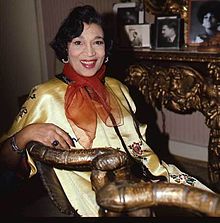
Next came Fred Astaire'due south last stage bear witness, Gay Divorce (1932).[53] Information technology featured a hit that became Porter's best-known song, "Night and Day".[due north ix] Despite mixed press (some critics were reluctant to accept Astaire without his previous partner, his sister Adele), the bear witness ran for a assisting 248 performances, and the rights to the film, retitled The Gay Divorcee, were sold to RKO Pictures.[due north 10] Porter followed this with a West End show for Gertrude Lawrence, Nymph Errant (1933), presented by Cochran at the Adelphi Theatre, where information technology ran for 154 performances. Among the hit songs Porter equanimous for the prove were "Experiment" and "The Physician" for Lawrence, and "Solomon" for Elisabeth Welch.[55]
In 1934, producer Vinton Freedley came upwardly with a new approach to producing musicals. Instead of commissioning book, music and lyrics and then casting the show, Freedley sought to create an ideal musical with stars and writers all engaged from the outset.[56] The stars he wanted were Ethel Merman, William Gaxton and comedian Victor Moore. He planned a story about a shipwreck and a desert isle, and for the book he turned to P. M. Wodehouse and Guy Bolton. For the songs, he decided on Porter. By telling each of these that he had already signed the others, Freedley gathered his ideal squad together.[n 11] A drastic last-minute rewrite was necessitated by a major shipping accident that dominated the news and made Bolton and Wodehouse'due south book seem tasteless.[north 12] Nevertheless, the evidence, Anything Goes, was an firsthand hit. Porter wrote what many consider his greatest score of this flow. The New Yorker mag's review said, "Mr. Porter is in class by himself",[59] and Porter subsequently called it i of his two perfect shows, along with the later Kiss Me, Kate.[59] Its songs include "I Get a Boot Out of You", "All Through the Night", "You're the Top" (i of his all-time-known list songs), and "Blow, Gabriel, Blow", as well equally the title number.[sixty] The show ran for 420 performances in New York (a particularly long run in the 1930s) and 261 in London.[61] Porter, despite his lessons in orchestration from d'Indy, did not orchestrate his musicals. Annihilation Goes was orchestrated past Robert Russell Bennett and Hans Spialek.[62] [northward thirteen] Now at the pinnacle of his success, Porter was able to enjoy the opening night of his musicals; he made thousand entrances and sat in front, apparently relishing the prove equally much as whatsoever audience member. Russel Crouse commented "Cole's opening-night behaviour is every bit indecent as that of a bridegroom who has a good time at his own wedding."[59]
Anything Goes was the first of five Porter shows featuring Merman. He loved her loud, flippant voice and wrote many numbers that displayed her strengths.[63] Jubilee (1935), written with Moss Hart while on a cruise around the world, was not a major hitting, running for just 169 performances, but it featured ii songs that accept since get standards, "Begin the Beguine" and "But I of Those Things".[64] Ruby-red, Hot and Blue (1936), featuring Merman, Jimmy Durante and Bob Hope, ran for 183 performances and introduced "It'southward De-Lovely", "Downward in the Depths (on the Ninetieth Floor)", and "Ridin' High".[65] The relative failure of these shows convinced Porter that his songs did not appeal to a broad enough audience. In an interview, he said "Sophisticated allusions are expert for about half-dozen weeks ... more fun, just only for myself and about eighteen other people, all of whom are first-nighters anyhow. Polished, urbane and adult playwriting in the musical field is strictly a creative luxury."[66]
Porter also wrote for Hollywood in the mid-1930s. His scores include those for the Metro-Goldwyn-Mayer films Built-in to Dance (1936), with James Stewart, featuring "You'd Be So Easy to Dear" and "I've Got You Under My Skin", and Rosalie (1937), featuring "In the Still of the Nighttime".[67] He wrote the score of the brusk picture show Paree, Paree, in 1935, using some of the songs from 50 1000000 Frenchmen.[68] Porter too composed the cowboy vocal "Don't Fence Me In" for Adios, Argentina, an unproduced movie, in 1934, but information technology did not go a hit until Roy Rogers sang it in the 1944 film Hollywood Canteen.[69] Bing Crosby, The Andrews Sisters, and other artists too popularized it in the 1940s. The Porters moved to Hollywood in Dec 1935, but Porter's married woman did not like the flick environment, and Porter's closeted homosexual acts, formerly very discreet, became less so; she retreated to their Paris firm.[70] [71] When his film assignment on Rosalie was finished in 1937, Porter hastened to Paris to make peace with Linda, but she remained cool. After a walking bout of Europe with his friends, Porter returned to New York in October 1937 without her.[72] They were soon reunited by an accident Porter suffered.[73]
On October 24, 1937, Porter was riding with Countess Edith di Zoppola and Duke Fulco di Verdura at Piping Rock Club in Locust Valley, New York, when his equus caballus rolled on him and crushed his legs, leaving him essentially crippled and in constant pain for the rest of his life. Though doctors told Porter's wife and female parent that his correct leg would have to be amputated, and possibly the left ane also, he refused to accept the procedure. Linda rushed from Paris to be with him, and supported him in his refusal of amputation.[74] He remained in the hospital for 7 months before being allowed to go domicile to his apartment at the Waldorf Towers.[75] [76] [due north 14] He resumed work as soon equally he could, finding it took his heed off his perpetual pain.[75]
Porter's kickoff evidence after his accident was not a success. Y'all Never Know (1938), starring Clifton Webb, Lupe Vélez and Libby Holman, ran for simply 78 performances.[78] The score included the songs "From Alpha to Omega" and "At Long Last Honey".[79] He returned to success with Exit Information technology to Me! (1938); the show introduced Mary Martin, singing "My Heart Belongs to Daddy", and other numbers included "Most Gentlemen Don't Like Love" and "From At present On".[eighty] Porter's concluding bear witness of the 1930s was DuBarry Was a Lady (1939), a peculiarly risqué show starring Merman and Bert Lahr.[81] Afterwards a pre-Broadway tour, during which it ran into problem with Boston censors,[82] it accomplished 408 performances, beginning at the 46th Street Theatre.[83] The score included "But in the Morning, No" (which was banned from the airwaves), "Practise I Dearest You?", "Well, Did Yous Evah!", "Katie Went to Haiti" and some other of Porter'due south upward-tempo list songs, "Friendship".[84] At the stop of 1939, Porter contributed half-dozen songs to the motion picture Broadway Melody of 1940 for Fred Astaire, George White potato and Eleanor Powell.[85]
Meanwhile, as political unrest increased in Europe, Porter's wife closed their Paris house in 1939, and the next year bought a country dwelling house in the Berkshire mountains, near Williamstown, Massachusetts, which she decorated with elegant furnishings from their Paris domicile. Porter spent fourth dimension in Hollywood, New York and Williamstown.[86]
1940s and postwar [edit]

Panama Hattie (1940) was Porter's longest-running hit and so far, running in New York for 501 performances despite the absence of any enduring Porter songs.[87] It starred Merman, Arthur Treacher and Betty Hutton. Let'southward Face It! (1941), starring Danny Kaye, had an even better run, with 547 performances in New York.[88] This, too, lacked whatever numbers that became standards, and Porter always counted it amongst his bottom efforts.[89] Something for the Boys (1943), starring Merman, ran for 422 performances, and Mexican Hayride (1944), starring Bobby Clark, with June Havoc, ran for 481 performances.[90] These shows, too, are curt of Porter standards. The critics did not pull their punches, complaining nearly the lack of hit tunes and the generally low standard of the scores.[91] Afterwards two flops, Seven Lively Arts (1944) (which featured the standard "Ev'ry Time We Say Goodbye") and Around the World (1946), many thought that Porter'due south best period was over.[92]
Betwixt Broadway musicals, Porter connected to write for Hollywood. His film scores of this period were You'll Never Become Rich (1941) with Astaire and Rita Hayworth, Something to Shout About (1943) with Don Ameche, Janet Blair and William Gaxton, and Mississippi Belle (1943–44), which was abandoned before filming began.[93] He too cooperated in the making of the moving-picture show Dark and Day (1946), a largely fictional biography of Porter, with Cary Grant implausibly cast in the lead. The critics scoffed, but the pic was a huge success, chiefly because of the wealth of vintage Porter numbers in it.[94] The biopic'due south success contrasted starkly with the failure of Vincente Minnelli'south motion-picture show The Pirate (1948), with Judy Garland and Gene Kelly,[95] in which five new Porter songs received trivial attention.[96]

From this low spot, Porter made a conspicuous comeback in 1948 with Kiss Me, Kate. It was by far his virtually successful show, running for i,077 performances in New York and 400 in London.[97] The product won the Tony Award for All-time Musical (the outset Tony awarded in that category), and Porter won for all-time composer and lyricist. The score includes "Another Op'nin', Another Show", "Wunderbar", "And so In Love", "Nosotros Open in Venice", "Tom, Dick or Harry", "I've Come to Wive It Wealthily in Padua", "Likewise Darn Hot", "Ever True to You (in My Fashion)", and "Brush Upwardly Your Shakespeare".[98]
Porter began the 1950s with Out of This Globe (1950), which had some good numbers simply too much campsite and vulgarity,[99] and was not greatly successful. His next show, Can-Can (1952), featuring "C'est Magnifique" and "It'south All Right with Me", was some other hit, running for 892 performances.[100] Porter's terminal original Broadway production, Silk Stockings (1955), featuring "All of You", was also successful, with a run of 477 performances.[101] Porter wrote two more film scores and music for a television set special earlier catastrophe his Hollywood career. The film High Gild (1956), starring Bing Crosby, Frank Sinatra and Grace Kelly, included Porter's last major hitting song "Truthful Beloved".[2] Information technology was adjusted every bit a stage musical of the aforementioned proper name. Porter as well wrote numbers for the film Les Girls (1957), which starred Cistron Kelly. His last score was for the CBS television special Aladdin (1958).[102]
Last years [edit]
Porter's mother died in 1952, and his wife died of emphysema in 1954.[103] By 1958, Porter's injuries caused a series of ulcers on his correct leg. After 34 operations, information technology had to be amputated and replaced with an artificial limb.[104] His friend Noël Coward visited him in the hospital and wrote in his diary, "The lines of ceaseless hurting have been wiped from his face...I am convinced that his whole life will cheer up and that his work will profit accordingly."[105] In fact, Porter never wrote another song later the amputation and spent the remaining half dozen years of his life in relative seclusion, seeing but intimate friends.[104] He continued to live in the Waldorf Towers in New York in his memorabilia-filled apartment. On weekends, he often visited an estate in the Berkshires, and he stayed in California during the summers.[25]
Porter died of kidney failure at age 73 on October 15, 1964, in Santa Monica, California.[106] He is interred in Mount Promise Cemetery in his native Peru, Indiana, between his wife and father.[107]
Tributes and legacy [edit]

Porter family unit gravesite in Peru, Indiana
Many artists have recorded Porter songs, and dozens have released entire albums of his songs.[108] In 1956, jazz singer Ella Fitzgerald released Ella Fitzgerald Sings the Cole Porter Songbook. In 1972, she released another collection, Ella Loves Cole. Among the many album collections of Porter songs are the following: Oscar Peterson Plays the Cole Porter Songbook (1959); Anita O'Twenty-four hour period Swings Cole Porter with Billy May (1959); All Through the Night: Julie London Sings the Choicest of Cole Porter (1965); Rosemary Clooney Sings the Music of Cole Porter (1982); Anything Goes: Stephane Grappelli & Yo-Yo Ma Play (Generally) Cole Porter (1989)[108] and Beloved for Auction (Tony Bennett and Lady Gaga, 2021).[109] In 1990 Dionne Warwick released Dionne Sings Cole Porter.[110] In that same twelvemonth, Red Hot + Blueish was released every bit a do good CD for AIDS enquiry and featured 20 Cole Porter songs recorded by artists such equally U2 and Annie Lennox.[111]
Additional recording collections include Frank Sinatra Sings the Select Cole Porter (1996)[112] and John Barrowman Swings Cole Porter (2004); Barrowman played "Jack" in the 2004 film De-Lovely.[113] Other singers who have paid tribute to Porter include the Swedish popular music group Gyllene Tider, which recorded a vocal called "Flickan i en Cole Porter-sång" ("That Girl from the Cole Porter Song") in 1982. He is referenced in the merengue vocal "The Call of the Wild" by David Byrne on his 1989 album Rei Momo. He likewise is mentioned in the song "Tonite It Shows" by Mercury Rev on their 1998 album Deserter'due south Songs. After Can-Can was adapted as a motion-picture show, the soundtrack won the 1960 Grammy Accolade for Best Sound Track Album.[114]
In 1965, Judy Garland performed a medley of Porter's songs at the 37th University Awards shortly after Porter'southward death.[115] In 1980, Porter'south music was used for the score of Happy New year, based on the Philip Barry play Holiday.[ citation needed ] The cast of The Carol Burnett Prove paid a tribute to Porter in a humorous sketch in their CBS idiot box series.[116] You're the Acme: The Cole Porter Story, a video of archival textile and interviews, and Red, Hot and Blue, a video of artists performing Porter'south music, were released in 1990 to celebrate the 1 hundredth anniversary of Porter'due south birth.[117] In dissimilarity to the highly embellished 1946 screen biography Night and 24-hour interval,[118] Porter's life was chronicled more realistically in De-Lovely, a 2004 Irwin Winkler motion-picture show starring Kevin Kline as Porter and Ashley Judd equally Linda.[119] The soundtrack to De-Lovely includes Porter songs sung by Alanis Morissette, Sheryl Crow, Elvis Costello, Diana Krall and Natalie Cole, amongst others.[120] Porter also appears as a character in Woody Allen's 2011 film Midnight in Paris.[121]
Many events commemorated the centenary of Porter'southward birth, including the halftime show of the 1991 Orange Bowl.[122] [123] Joel Grey and a big cast of singers, dancers and marching bands, performed a tribute to Porter in Miami, Florida during the 57th King Orange Jamboree parade, whose theme was "Anything Goes".[124] [125] The Indianapolis Symphony Orchestra performed a program of Cole Porter music at the Circumvolve Theatre in Indianapolis, which also featured clips of Porter'southward Hollywood films.[123] "A Gala Birthday Concert" was held at New York City's Carnegie Hall, with more than than 40 entertainers and friends paying tribute to Porter's long career in theater and picture show.[117] In addition, the U.South. Postal Service issued a commemorative postage postage stamp honoring Porter'southward birth.[126] The Indiana Academy Opera performed Porter's musical, Jubilee, in Bloomington, Indiana.[127]
In May 2007, a star on the Hollywood Walk of Fame was dedicated to Cole Porter.[128] In December 2010, his portrait was added to the Hoosier Heritage Gallery in the function of the Governor of Indiana.[129] Numerous symphony orchestras have paid tribute to Porter in the years since his death[130] [131] including Seattle Symphony Orchestra, with Marvin Hamlisch as conductor[132] and the Boston Pops, both in 2011.[133] [due north xv] In 2012, Marvin Hamlisch, Michael Feinstein, and the Dallas Symphony Orchestra honored Porter with a concert that included his familiar classics.[135] The Cole Porter Festival is held every year in June in his hometown of Republic of peru, Indiana, to foster music and art appreciation.[136] Costumed singers in the cabaret-way Cole Porter Room at the Indiana Historical Society'southward Eugene and Marilyn Glick Indiana History Middle in Indianapolis take requests from visitors and perform Porter'due south hit songs.[n 16] Since Porter's death, except for a brief fourth dimension at the New York Historical Social club, his 1908 Steinway chiliad piano, which he had used when composing since the mid-1930s, has been displayed and often played in the lobby of the Waldorf-Astoria Hotel.[138] Porter is a member of the American Theater Hall of Fame[139] and Great American Songbook Hall of Fame, which recognized his "musically complex [songs] with witty, urbane lyrics".[140] In 2014, Porter was honored with a plaque on the Legacy Walk in Chicago, which celebrates LGBT achievers.[141] [142]
Notable songs [edit]
Shows listed are phase musicals unless otherwise noted. Where the show was later fabricated into a film, the year refers to the stage version. A consummate list of Porter'southward works is in the Library of Congress (see likewise the Cole Porter Collection).[north 17]
|
|
A more comprehensive list of Cole Porter songs, forth with their appointment of composition and original show, is available online at the "Cole Porter Songlist Folio".[143]
Notes, references, sources and farther reading [edit]
Notes [edit]
- ^ Porter's parents had 2 children who died in infancy before his birth – Louis Omar (b. and d. 1885) and Rachel (1888–ninety).[1]
- ^ Porter's father came to Republic of peru, Indiana, from Vevay, Indiana. He eventually endemic three drugstores in Peru.[4]
- ^ Porter'southward great-grandfather, A. A. Cole, had come to Peru, Indiana, in 1834 from Connecticut, as a kid. J. O. Cole grew up in Peru just moved westward during the Gilt Rush of 1849. He made his fortune in California and invested it in Indiana farmland and Due west Virginia timber, coal, and oil.[6]
- ^ He after enlisted in the First Foreign Regiment, before moving to other regiments prior to his April 1919 belch.[22]
- ^ She divorced newspaper mogul Edward R. Thomas in 1912, receiving more than a million dollars in the divorce settlement.[27]
- ^ Porter had "frequent homosexual encounters"[29]
- ^ The British classical music journal The Musical Times commented, "There was plenty of excitement of a certain kind – at to the lowest degree for the more than excitable spectators".[35]
- ^ The Porters were non profoundly afflicted by the crash, having their assets in rubber investments and held in a number of strange banks, which remained solvent.[43]
- ^ In 1999, Matthew Shaftel wrote, "Less than two months after the show's opening ... the song was featured on ii best-selling recordings and was at the top of sheet music sales. Since and so, 83 artists have registered with the [ASCAP] ... to legally perform and record "Nighttime and Day." [Fifty-fifty] today, more than 65 years after its limerick, the song earns a stunning six figures, making information technology Warner Brothers' "crown precious stone", and placing it on ASCAP's list of top money-earners of all fourth dimension.[three]
- ^ The film version, starring Astaire and Ginger Rogers dropped all of Porter's score except "Nighttime and Mean solar day"[54]
- ^ Freedley told Bolton and Wodehouse that he had secured Merman, then contacted Gaxton, Moore, and finally Merman.[57]
- ^ In 1934, the S.S. Morro Castle caught fire off the New Jersey shore, killing more 100 people.[58] Bolton and Wodehouse were past so engaged in other work, and Howard Lindsay and Russel Crouse rewrote the volume almost completely.[59]
- ^ Other Porter shows were orchestrated by Maurice B. DePackh, Walter Paul, Don Walker and Philip J. Lang: meet Kimball (1991) pp. 2–3. Porter checked the orchestral parts and amended them as he felt necessary.[iii]
- ^ Linda, appraising the deteriorating political outlook in Europe, airtight the Paris business firm in April 1939.[77]
- ^ In 2012, the Boston Pops presented another tribute to Porter.[134]
- ^ The setting is designed to evoke the Waldorf Astoria New York, where Porter lived.[137]
- ^ All the songs beneath (except for "Come up to the Supermarket", which is listed in this compilation), are included in one or more than of the compilations of Porter songs listed at "A Cole Porter Bibliography" on Soundheimguide.com, accessed March ten, 2011
References [edit]
- ^ McBrien (1998), p. 11
- ^ a b c d Derbyshire, John. "Oh, the Songs!" Archived January thirty, 2013, at archive.today, National Review Online, July 28, 2004, accessed May 27, 2010
- ^ a b c d due east f Shaftel, Matthew. "From Inspiration to Annal: Cole Porter'southward 'Dark and Twenty-four hours'", Journal of Music Theory, Knuckles University Printing, Volume 43, No. 2 (Autumn, 1999), pp. 315–47, accessed March 7, 2011 (subscription required)
- ^ McBrien (1998), p. eight
- ^ a b c d e f g h i Bell, J. Ten. "Cole Porter Biography" Archived September 23, 2010, at the Wayback Machine, The Cole Porter Resource Site, accessed March 7, 2011
- ^ McBrien (1998), pp. four–five.
- ^ Schwartz (1977), p. 11
- ^ Schwartz (1977), p. 18
- ^ a b McBrien (1998), p. 10.
- ^ a b McBrien (1998), p. 21
- ^ McBrien (1998), p. 26
- ^ "The Theater: The Professional Apprentice", Time magazine, January 31, 1949
- ^ a b c d Kimball (1999), p. i.
- ^ Seuss (2012), p. ten
- ^ a b McBrien (1998), p. 32.
- ^ "Yale Fight Songs", Yale Bands, Yale University, accessed February 21, 2020
- ^ Schiff, David. "One Swell Party", The Atlantic, July/August 2004, accessed April 2, 2020
- ^ Ewen, David. "Cole Porter: The Great Sophisticate", from The Story of America'due south Musical Theater, New York, Chilton Visitor, 1961, pp. 134–39
- ^ Algeo, p. 144
- ^ a b Root, Deane Fifty. and Gerald Bordman. "Porter, Cole (Albert)", Grove Music Online, accessed May 21, 2010 (requires subscription)
- ^ Kimball (1992), p. 1.
- ^ McBrien (1998), p. 59
- ^ "French Foreign Legion Official web site". Legion-etrangere.com. July 13, 2016. Retrieved September 10, 2016.
- ^ Salazar, Jaime. Legion of the Lost Archived December 23, 2008, at the Wayback Car, Legionofthelost.com, 2005, accessed September 16, 2016
- ^ a b c d "Obituary: Cole Porter is Dead; Songwriter Was 72", The New York Times, October 16, 1964
- ^ Citron (2005), p. 48
- ^ a b McBrien (1998), p. 65
- ^ McBrien (1998), p. 70
- ^ Citron (2005), p. 142; and Schwartz (1977), p.114
- ^ "Cole Porter – The Twenties", The Stephen Sondheim Reference Guide, accessed February 28, 2011
- ^ a b Kimball (1992), p. 2
- ^ Citron (2005), p. 58
- ^ Kimball (1991), pp. 4–five
- ^ a b Kimball (1991), p. 5
- ^ "Paris", The Musical Times, December 1923, p. 874
- ^ Kimball (1991), p. 6
- ^ Kimball (1984), p. 85
- ^ a b Kimball (1999), p. 5
- ^ Citron (2005), p. 73
- ^ Kimball (1984), pp. 101 and 104
- ^ Citron (2005), pp. 74 and 79
- ^ Citron (2005), p. 78
- ^ Citron (2005), p. 85
- ^ Citron (2005), pp lxxx–82
- ^ Citron (2005), pp. 82–83
- ^ Citron (2005), p. 83
- ^ Kimball (1984), pp. 117–29
- ^ Citron (2005), p. 84
- ^ Citron (2005), p. 100
- ^ Citron (2005), p. 101
- ^ Kimball (1984), p. 145
- ^ Kimball (1984), p. 147
- ^ "Gay Divorce – Original Broadway Product", Sondheimguide.com, accessed April 16, 2016
- ^ Citron (2005), p. 105
- ^ Kimball (1984), pp. 158–62
- ^ Citron (2005), p. 108
- ^ Citron (2005), p. 109
- ^ Kimball (1992), p. 70, and McBrien (1998), p. 164
- ^ a b c d Citron (2005), p. 110
- ^ Kimball (1984), pp. 167–76
- ^ Citron (2005), p. 111
- ^ McGlinn, John (1989), "The Original Annihilation Goes: A Archetype Restored", Notes to EMI CD CDC 7 49848 2
- ^ Citron (2005), p. 141
- ^ Kimball (1984), pp. 183–96
- ^ Kimball (1984), pp. 205–sixteen
- ^ Kimball (1984), p. 205.
- ^ Kimball (1992), p. 9
- ^ Paree, Paree, SoundheimGuide, accessed Feb thirteen, 2013
- ^ Kimball (1992), p. 7
- ^ Citron (2005), p. 143
- ^ McBrien (1998), pp. 189, 193, 206 and 209
- ^ McBrien (1998), p. 209.
- ^ Citron (2005), p. 144
- ^ Citron (2005), p. 145
- ^ a b Citron (2005), p. 162
- ^ Harriman, Margaret Example. "Words and Music", The New Yorker, November 23, 1940, accessed June 17, 2018
- ^ Citron (2005), p. 168
- ^ Kimball (1984), p. 225
- ^ Kimball (1984), pp. 227 and 229
- ^ Kimball (1984), pp. 241 and 243
- ^ Citron (2005), p. 184
- ^ Kimball (1984), p. 260
- ^ Kimball (1984), p. 256
- ^ Kimball (1984), pp. 259–67
- ^ Kimball (1984), pp. 252–54
- ^ McBrien (1998), p. 225
- ^ Citron (2005), p. 185
- ^ Kimball (1984), p. 299
- ^ Citron (2005), p. 189
- ^ Kimball (1984), pp. 320 and 343
- ^ Citron (2005), p. 190
- ^ Citron (2005), p. 193
- ^ Kimball (1984), pp. 295, 313 and 335
- ^ Citron (2005), pp. 211–fourteen
- ^ Kimball (1992), p. 13–fifteen
- ^ Citron (2005), p. 215
- ^ Citron (2005), p. 419
- ^ Kimball (1984), pp. 387–99
- ^ Citron (2005), p. 220
- ^ Kimball (1984), p. 422
- ^ Kimball (1984), p. 438
- ^ Kimball (1984), p. 468
- ^ Citron (2005), pp. 239 and 242
- ^ a b Citron (2005), p. 249
- ^ Coward (1982), p. 379
- ^ Davis, Charles Jr. "Songwriter Cole Porter Dies", Los Angeles Times, October 16, 1964, accessed November 24, 2021
- ^ Schwartz (1977), p. 269
- ^ a b Listing of Cole Porter collections at Sondheimguide.com, accessed June 9, 2011
- ^ Wilman, Chris (August iii, 2021). "Tony Bennett and Lady Gaga Reveal Love for Sale, Cole Porter Tribute Anthology Said to Be Bennett'southward Terminal". Variety. Archived from the original on August 3, 2021. Retrieved August 3, 2021.
- ^ Discogs.com, accessed February 22, 2012.
- ^ Discogs.com, accessed February 22, 2012.
- ^ Sondheim Guide, accessed February 22, 2012.
- ^ Sondheim Guide, accessed February 22, 2012.
- ^ "Cole Porter", Grammy.com, accessed December 30, 2021
- ^ "The 37th Academy Awards Memorable Moments", Oscars.org, accessed Dec 13, 2019
- ^ "The Carol Burnett Testify – Tribute to Cole Porter" on YouTube, accessed September 20, 2012.
- ^ a b Howard Reich, "Porter Tributes: A Few Highlights", Chicago Tribune", May 5, 1991, accessed September 20, 2012.
- ^ Classicfilmguide.com, accessed February 27, 2012.
- ^ Johnston, Sheila. "How Cole Porter got his kicks?" Archived May 10, 2007, at the Wayback Automobile All About Jewish Theatre (2004), accessed May 27, 2010
- ^ Phares, Heather. "Original Soundtrack" De-Lovely", Allmusic, accessed April 30, 2014
- ^ "The Better Life", The New Yorker, May 23, 2011
- ^ Kimball, Robert. "Cole Porter, College Man" Archived November 14, 2012, at the Wayback Auto, Yale Alumni Mag, November 1992, accessed May 17, 2012
- ^ a b Holland, Bernard. "A Hoosier Hurrah on Cole Porter's Centennial", The New York Times, June 9, 1991, accessed May 17, 2012
- ^ TCM Turner Classic Movies, "1990 King Orange Jamboree Parade", Turner Entertainment Networks, December 31, 1990, accessed September 20, 2012.
- ^ Luisa Yanez, "500,000 At Parade Ooh, Aah King Orange Reigns Nether Miami Moon", Sun-Picket, January 1, 1991, retrieved September twenty, 2012.
- ^ Randolph Eastward. Schmid, "Basketball, Early Warren and Cole Porter Set for 1991 Stamps", Associated Press, Essential New Archives, accessed September 20, 2012.
- ^ Clair McPhail, "Year-long celebration to honor Cole Porter", The News Courier/The Evening Post, Charleston, Southward Carolina, August 12, 1990, retrieved September 20, 2012.
- ^ "Hollywood star for Cole Porter", USA Today, May 21, 2007, via Associated Press. Retrieved September 20, 2012.
- ^ Video on YouTube, accessed February 21, 2012.
- ^ "NSO at Wolf Trap: 'A Cole Porter Commemoration' ", The John F. Kennedy Middle for the Performing Arts, retrieved September 20, 2012.
- ^ "Religion Middleton Show: A Tribute to Cole Porter and Glen Miller", "The Faith Middleton Show", Connecticut Public Broadcasting, Nov 22, 2010, accessed September twenty, 2012.
- ^ "A Tribute to Cole Porter" Archived Jan 16, 2013, at the Wayback Machine, Seattle Symphony Orchestra, accessed September 20, 2012
- ^ Meland, Manny. "Boston Pops in A Tribute to Cole Porter with Conductor Keith Lockhart" Archived Jan sixteen, 2013, at the Wayback Machine, Miamiartzine, March seven, 2011, retrieved September 20, 2012.
- ^ "Boston Pops Presents Tribute to Cole Porter on June five–6", MassJazz blog, accessed September twenty, 2012.
- ^ "DSO Pops Series: Cole Porter Tribute with Michael Feinstein and Marvin Hamlisch", Last.fm, accessed September 20, 2012.
- ^ Cole Porter Festival, accessed September twenty, 2012.
- ^ Granger, Elizabeth. "Hoosier History", Habitation & Abroad, January 2015, p. 37
- ^ "Cole Porter'due south Piano", Atlas Obscura, accessed August xv, 2021; and Martinez, Jose. "Cole Porter's flat at the Waldorf-Astoria tin be yours for $140K a month", New York Daily News, July 20, 2010, accessed May 16, 2014
- ^ "Members", Theater Hall of Fame, accessed Oct 14, 2014
- ^ "Cole Porter: 2012 legend Honor", Groovy American Songbook Foundation, accessed June 16, 2019; and Miller, p. 182
- ^ "Legacy Walk honors LGBT 'guardian angels'", Chicago Tribune, October 12, 2014.
- ^ Reynolds, Daniel. "vii LGBT Heroes Honored With Plaques in Chicago's Legacy Walk", Advocate.com, October 11, 2014
- ^ "Cole Porter Songlist Page". Accessed May 27, 2010
Sources [edit]
- Algeo, Matthew (2011). Harry Truman's Excellent Hazard: The True Story of a Great American Road Trip. Chicago: Chicago Review Printing. ISBN9781569767078.
- Citron, Stephen (2005). Noel & Cole: the Sophisticates. Milwaukee: Hal Leonard Corporation. ISBN0634093029.
- Coward, Noël (1982). Graham Payn; Sheridan Morley (eds.). The Noël Coward Diaries (1941–1969). London: Methuen. ISBN0-297-78142-one.
- Kimball, Robert, ed. (1984). The Consummate Lyrics of Cole Porter. New York: Vintage Books. ISBN0-394-72764-9.
- Kimball, Robert (1991). Cole Porter: Overtures and Ballet Music, Liner note to EMI CD CDC 7 54300 2 . London: EMI Records. OCLC 315563881.
- Kimball, Robert (1992). "Cole Porter". You lot're the Top: Cole Porter in the 1930s. Indianapolis: Indiana Historical Society. ISBN0-871-95089-8.
- Kimball, Robert (1999). "Cole Porter". Yous're Sensational: Cole Porter in the '20s, '40s, & '50s. Indianapolis: Indiana Historical Society. ISBN0-871-95129-0.
- McBrien, William (1998). Cole Porter: A Biography. New York: Alfred A. Knopf. ISBN0-394-58235-seven.
- Miller, Michael (2008). The Consummate Idiot's Guide to Music History. Penguin. ISBN978-1-440-63637-0.
- Schwartz, Charles (1977). Cole Porter: A Biography. New York: Da Capo Press. ISBN0-306-80097-7.
- Seuss, Dr (2012). Richard Marschall (ed.). But What the Doctor Disordered: Early Writings and Cartoons of Dr. Seuss. Mineola, NY: Dover. ISBN978-0486498461.
Further reading [edit]
- Greher, Gena R. "Night & Twenty-four hour period: Cole Porter, hip hop, their shared sensibilities and their teachable moments." College Music Symposium. Vol. 49. 2009. online
- Hill, Edwin. "Making claims on echoes: Dranem, Cole Porter and the biguine betwixt the Antilles, France and the United states of america." Popular Music 33.iii (2014): 492–508.
- McAuliffe, Mary. When Paris Sizzled: The 1920s Paris of Hemingway, Chanel, Cocteau, Cole Porter, Josephine Bakery, and Their Friends (Rowman & Littlefield, 2016). ISBN 1442253320 [ place missing ]
- Porter, Cole. The Letters of Cole Porter (Yale Academy Press, 2019). ISBN 030021927X [ identify missing ]
- Randel, Don Thousand., Matthew Shaftel, and Susan Forscher Weiss, eds. A Cole Porter Companion; (U of Illinois Press, 2016). ISBN 0252040090 [ identify missing ]
- Savran, David. "'You've got that thing': Cole Porter, Stephen Sondheim, and the Erotics of the List Vocal." Theatre Journal (2012): 533–548. online
- Spirou, Penny. "From Night and Day to De-Lovely: cinematic representations of Cole Porter." Refractory: a journal of entertainment media 18 (2011): 1–13.
- Wells, Ira. "Swinging Modernism: Porter and Sinatra beneath the Skin." University of Toronto Quarterly 79.3 (2010): 975–990.
External links [edit]
- Works by or most Cole Porter at Internet Archive
- Cole Porter at Curlie
- Cole Porter discography at Discogs
- Cole Porter at the Internet Broadway Database

- Cole Porter at the Internet Off-Broadway Database
- Cole Porter at IMDb
- Cole Porter Birthplace & Museum
- Cole Porter Festival
- Cole Porter Collection at the Library of Congress
- Cole Porter recordings at the Discography of American Historical Recordings.
DOWNLOAD HERE
Posted by: herrerabetaletted.blogspot.com
Post a Comment